Introduction
Ask for Citibank’s Legal Entity Identifier (LEI) and you will get an answer within seconds—from a colleague, a search engine or an AI assistant. It will most likely be E57ODZWZ7FF32TWEFA76, the LEI of Citibank, N.A. Is it right? That depends on which Citibank you meant.
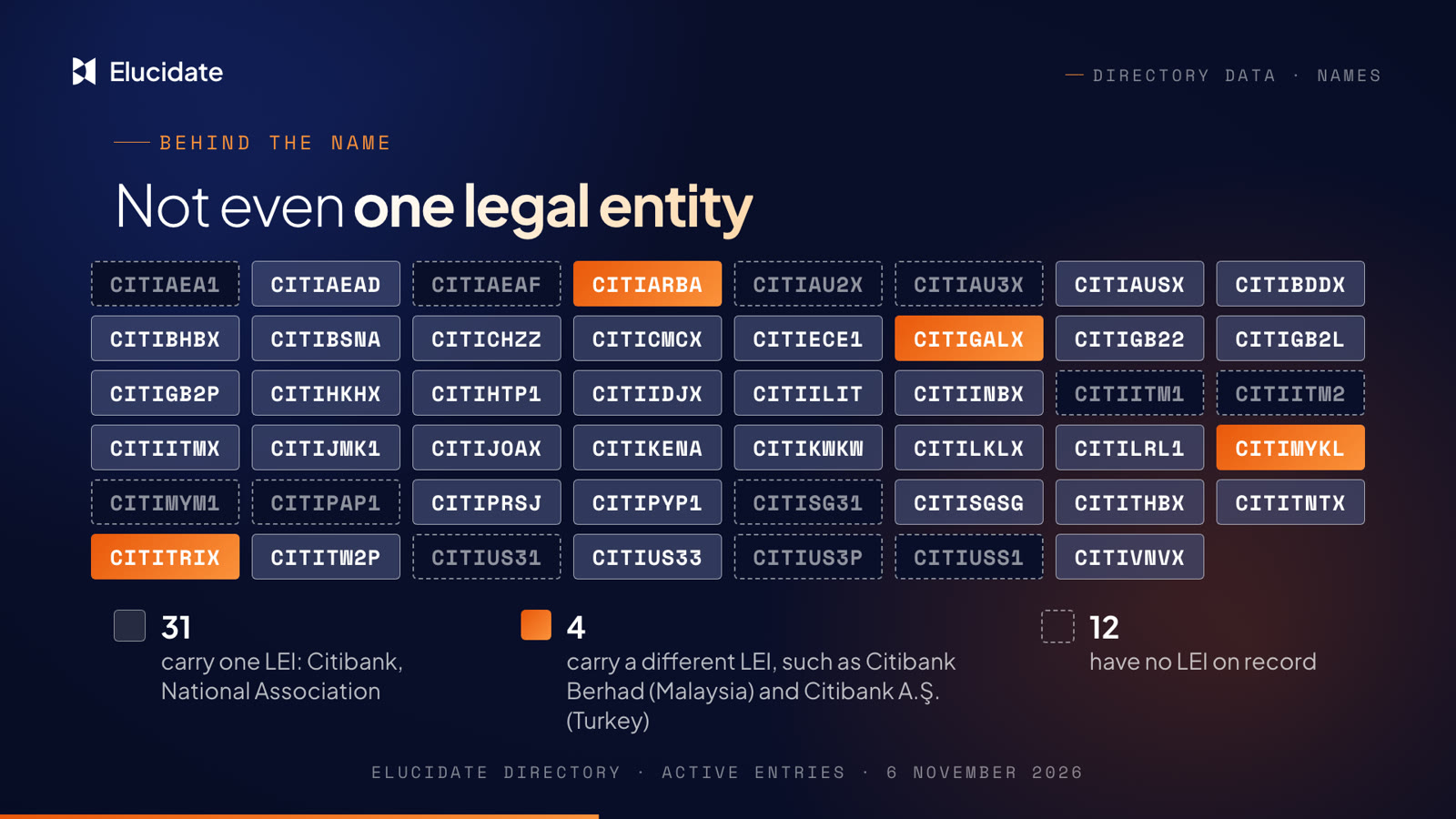
In the Elucidate Bank & Firm Directory, the name “Citibank”, once legal forms such as “N.A.” are set aside, is on 47 entries in 34 countries. Most of them belong to one legal entity. Not all of them do.
We made a short video of what that looks like, and of what settles the question.
One name, many entries
The directory holds one entry for each BIC8 in Swift’s directory of Business Identifier Codes (BICs), and one for each firm on the 22 regulator registers we track that is not already part of another entry. On 6 November 2026, 71,114 of those entries were active.
Compare their names with legal-form words such as Ltd, AG, plc and N.A. removed, and 3,993 names are each on more than one entry: 10,310 entries in all. 1,195 of those names appear in more than one country. The large international banks lead the count. Deutsche Bank is on 48 entries in 16 countries, Citibank on 47 in 34, Standard Chartered Bank on 28 in 21 and State Bank of India on 21 in 17.
Entries are not companies. Many are offices of a single legal entity, each with its own BIC8: that is how international banks are organised, and there is nothing unusual about it. For Citibank, 31 of the 47 entries carry the LEI of Citibank, National Association, the US national bank.
Not even one legal entity
The other 16 are where a name stops being enough. Four carry a different LEI, among them Citibank Berhad in Malaysia and Citibank A.Ş. in Turkey: banks incorporated in their own countries, each with its own LEI. Twelve have no LEI on record at all.
For a compliance team, the difference is not academic. The legal entity is what holds the licence, signs the contract, carries the credit exposure and is named, or not named, on a sanctions list. Two entries that share a name can differ on every one of those points.
Why an answer built on a name has to guess
An AI assistant asked about “Citibank” faces the same problem as an analyst with a search box—only faster, and at scale. A model that answers from what it has read will tend to give the most common answer: the LEI of Citibank, N.A. That answer is right for 31 of the 47 entries. Nothing in it tells you whether your Citibank is one of the other 16.
The consequences multiply as assistants become agents. An agent that screens counterparties, fills in an onboarding file or reconciles payment data passes its first resolution on to every step that follows. If it resolved the wrong entity, every later check is accurate about the wrong institution.
The answer is not a cleverer model. It is better data: records keyed on identifiers, with every fact traced to its source.
Identifiers end the search
A BIC8 picks one entry in Swift’s directory: CITIMYKL is Citibank Berhad, and nothing else. An LEI, defined by ISO 17442, picks one legal entity, and its record says who that entity is and, where it is reported, who owns it. GLEIF and Swift have published a free monthly BIC-to-LEI relationship file since February 2018, so the two can be joined without guesswork. And the Financial Stability Board (FSB) has set out options to widen the use of the LEI in cross-border payments, citing its value for know-your-customer checks and straight-through processing.
The directory works the same way. It links a register entry to a BIC only when both carry the same LEI, then checks that the names and the countries agree. The name is evidence, never the key.
Where Elucidate can help
The Elucidate Bank & Firm Directory is a free search of Swift’s BIC directory and the 22 registers we track, by BIC, LEI or licence number, with the source and date of every fact. For AI agents, the same data is available through the directory’s MCP server, so an assistant can look up an institution by its identifier rather than guess from its name.
Identification is where due diligence starts. For banks and payment firms that need to go further, the Elucidate FinCrime Index (EFI) is an independent score of the financial crime risk of banks and payment firms—comparable to a credit risk rating, applied to financial crime.
A name tells you where to look. An identifier tells you what you have found. Neither tells you how much risk it carries.