Introduction
We publish a directory of banks and payment firms: the institutions in Swift’s BIC directory and the firms on the public registers we read, each with its identifiers, its licences and the sources behind them. We built it for people who need to know who a counterparty is. We wanted to know who actually reads it, so we looked at a week of our own request logs, from 22 to 28 October 2026.
The short answer is machines. The video shows the week in shares; the rest of this post explains what the shares mean, and what we have done about them.
Most readers are machines
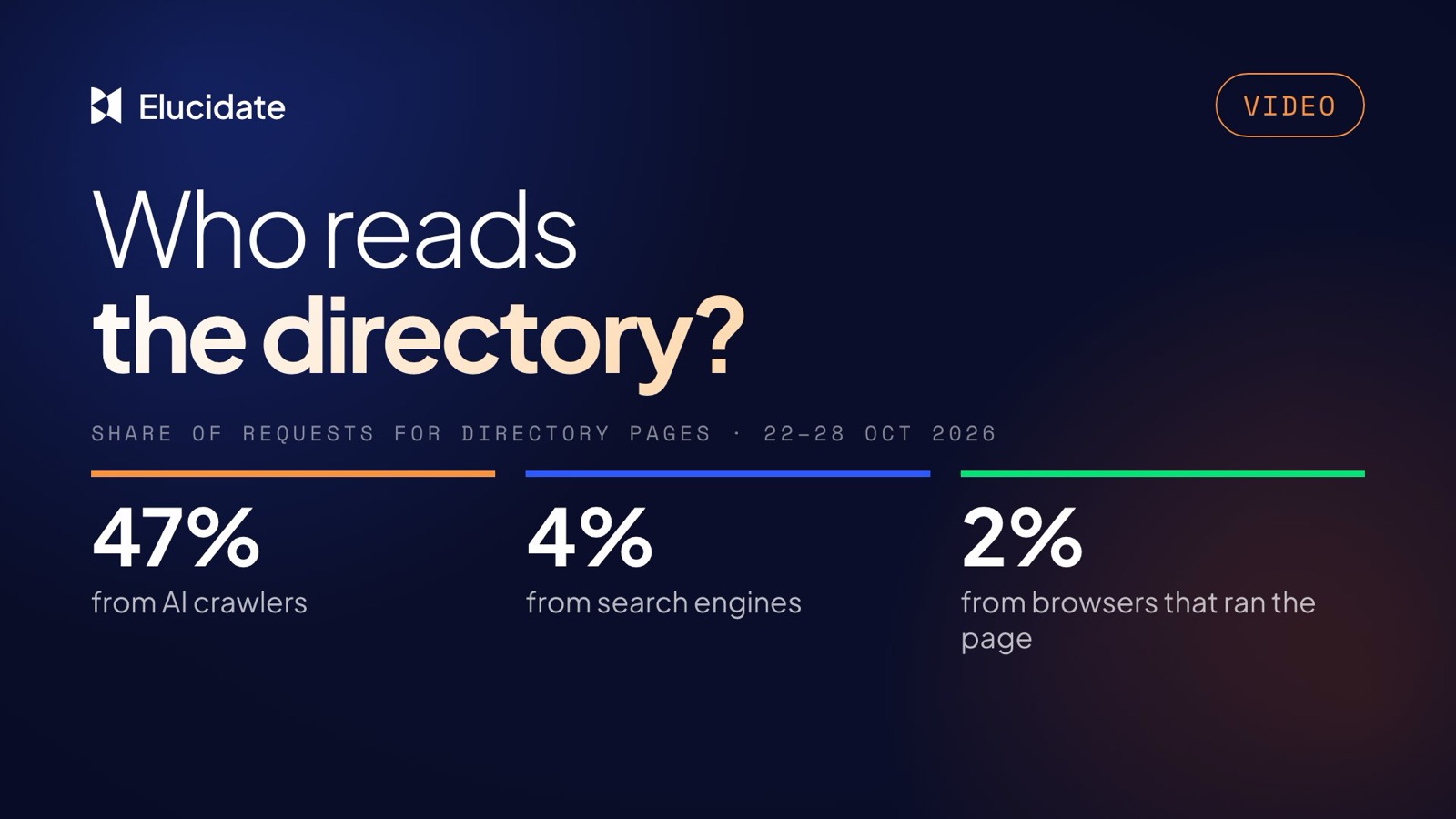
Of the successful requests for directory pages that week, 47% came from AI crawlers: the bots that collect pages for AI models and AI search. Another 42% came from clients that present themselves as browsers but never ran the page’s script, almost all of them scrapers. Search engine crawlers made 4%; other bots, scripts and monitoring checks 5%; and AI assistants fetching a page for someone 0.3%.
That leaves 2% from browsers that ran the page’s script. It is the closest a server log comes to a person, and it is not a count of people: some scripts run a page’s code too. Logs cannot count readers, and we don’t pretend they can. What they do show is the order of magnitude, and here it is not in doubt.
The AI crawlers
AI crawlers are not reading the site at random. In the same week, 98% of their requests to elucidate.co were for the directory. By operator, as each crawler declares itself, Meta made 74% of the AI-crawler requests for the directory, Amazon 12%, Exa 5%, Perplexity 4% and OpenAI 2%; smaller crawlers made the remaining 3%.
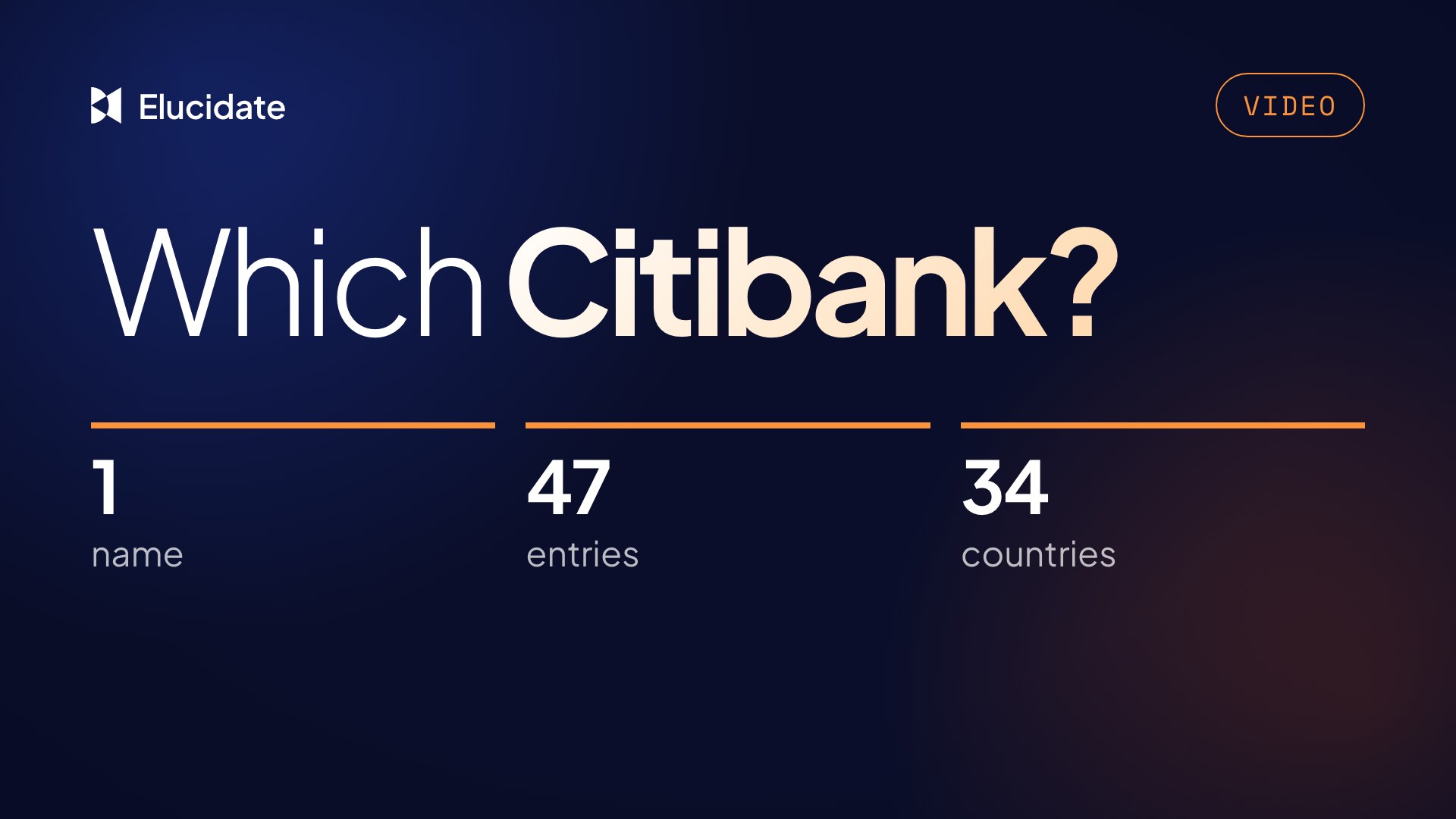
Our reading is simple. Models want structured facts about institutions, with identifiers that tell one bank from another. Names alone don’t do that, as our look at the institutions called Citibank shows.
For a person, right now
One small class of traffic deserves more attention than its share suggests. When someone asks an AI assistant about a bank, the assistant may fetch a page to answer, there and then. Those fetches were 0.3% of the requests for directory pages, and 83% of them came from ChatGPT. Each one is a person asking about an institution at that moment.
The assistant reads the page and answers; the person need not visit it. Visits, meanwhile, still come from search: of the visits that arrived from a search engine’s or an assistant’s link, 99% came from Google and 0.7% from ChatGPT.
Why every page has a Markdown twin
If most readers are machines, a page should be easy for a machine to read. So every public page on elucidate.co has a Markdown twin: add .md to the address. llms.txt lists the key pages for language models, and the directory has an MCP server, which lets an assistant look an institution up with tools rather than by reading a web page. In the same week, 8% of the requests for directory pages already asked for the Markdown version.
None of this changes what a page says. The Markdown carries the same facts, sources and dates as the page people see, so an agent quoting the directory cites exactly what a person would read.
How we counted
The figures come from elucidate.co’s request logs (Firebase Hosting) for 22 to 28 October 2026. Each request is classified by the user agent the client declares; a client can claim to be something it isn’t, and the classes are only as reliable as those declarations. Directory pages are successful requests for pages under /directory, Markdown twins included, and exclude the directory’s API and share images. A browser “ran the page’s script” if its address also loaded the site’s scripts that day. Referred visits are browser page loads whose referrer is a search engine or an assistant. Every figure is a share of requests or visits for that week, rounded to a whole number, except shares under 1%.
Where Elucidate can help
The directory is free, for people and for agents. Our page for agents explains how to read it: Markdown by address, llms.txt, the JSON API and the MCP server. Our recorded MCP session shows an assistant answering a counterparty question from it, with a source and a date for every fact.
For the question a directory cannot answer, how much financial crime risk a counterparty carries, the Elucidate FinCrime Index (EFI) scores banks and payment firms, comparable to a credit risk rating, applied to financial crime.
Write for the people who need the answer. Expect machines to read it first.