Introduction
AI agents are starting to do the first pass of counterparty work: pulling an institution’s identifiers, its licences, its sanctions exposure and its owners into an onboarding file before an analyst reads it. How good that first pass is depends less on the model than on what the model can look up—and on whether it can say where each answer came from.
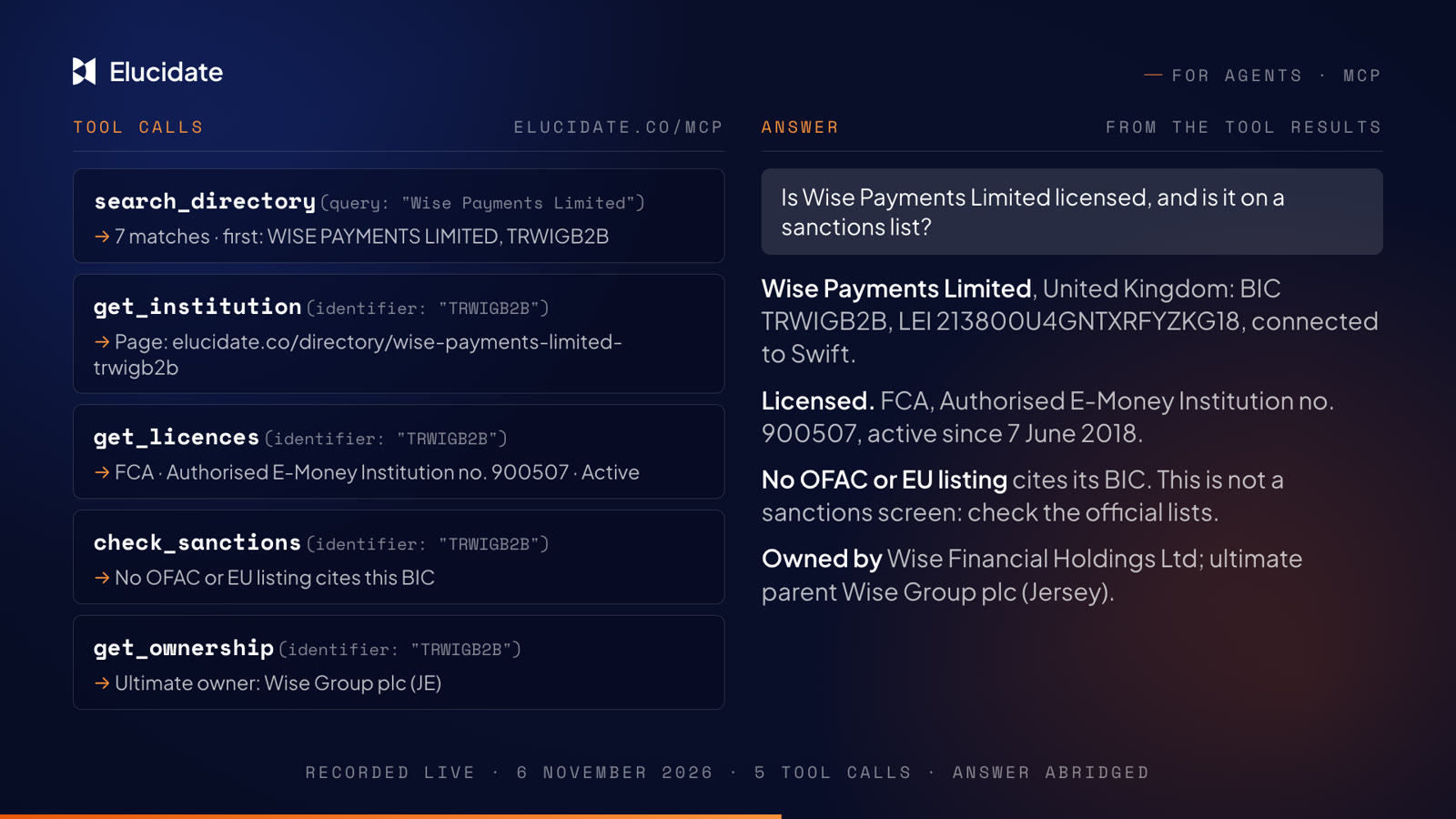
So we tried it. We connected an assistant to the Model Context Protocol (MCP) server of the Elucidate Bank & Firm Directory and asked one question: is Wise Payments Limited licensed, and is it on a sanctions list? The video shows the session as it was recorded on 6 November 2026.
What the agent did
The agent made five calls, in the order a compliance analyst would work:
search_directoryfound seven entries for “Wise Payments Limited”: four BIC8s of the UK company, all with the same Legal Entity Identifier (LEI), and three companies with similar names in Hong Kong, Thailand and New Zealand. The name alone did not settle which one was meant; the identifiers did.get_institutionreturned the head-office page forTRWIGB2B, with Swift’s BIC data as at 24 October 2026.get_licencesreturned one active entry: the Financial Conduct Authority (FCA) lists the company as an Authorised E-Money Institution, number 900507, since 7 June 2018. The register was retrieved on 25 September 2026.check_sanctionsfound no OFAC or EU listing that cites the BIC, against the lists as matched on 21 and 23 October 2026—and said in the same answer that this is not a sanctions screen.get_ownershipreturned the control chain at Companies House as at 9 October 2026: Wise Financial Holdings Ltd holds 75% or more of the shares and votes, with Wise Group plc of Jersey at the top.
None of this is new information about Wise. What is worth noticing is the shape of the answer: every line carries a source and a date, and the one line that could be misread—“no listing”—arrives with its limit attached.
What makes data agent-ready
A model can write a fluent paragraph about any bank. Whether that paragraph can go into an onboarding file depends on three properties of the data behind it.
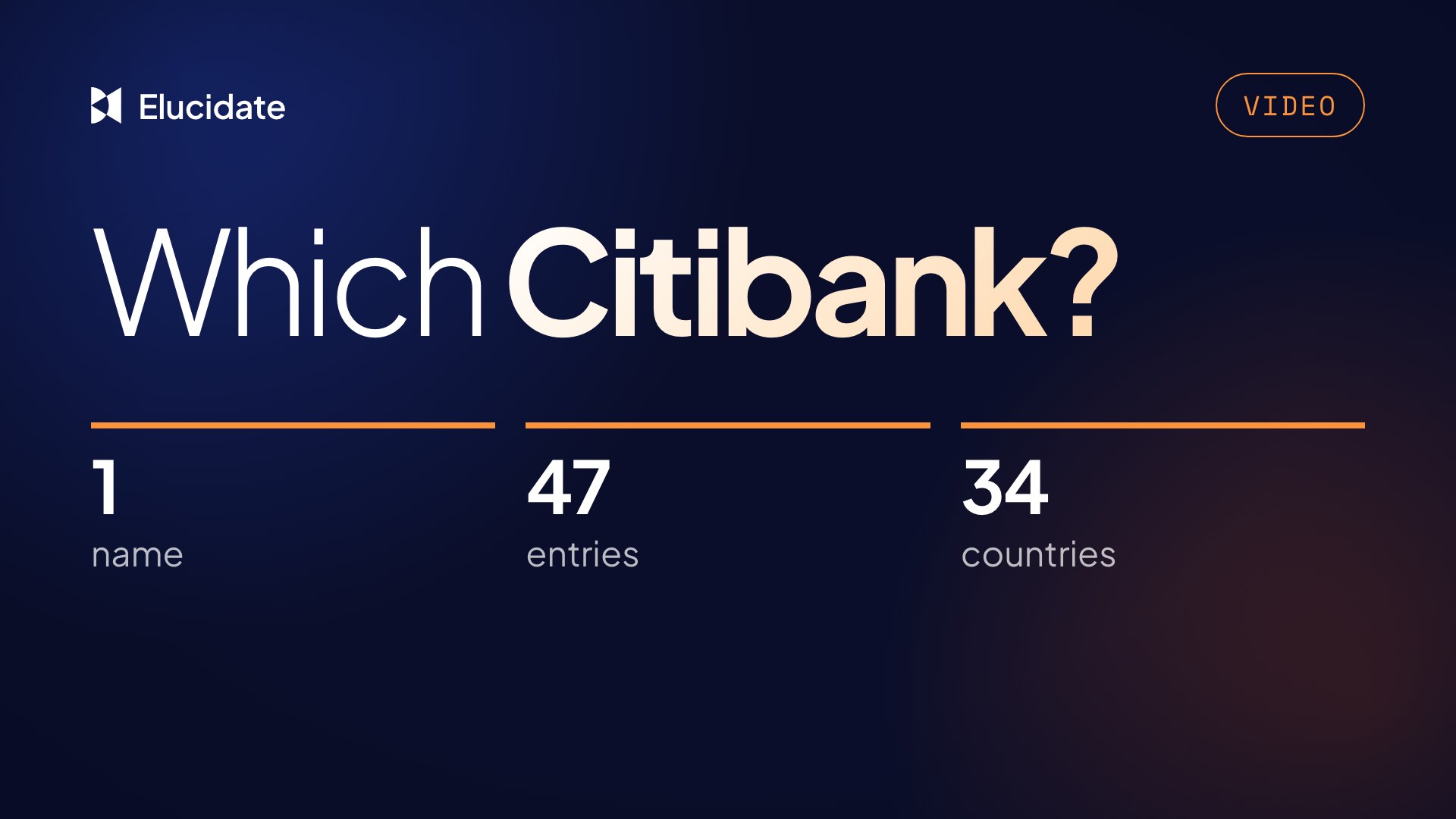
- Identifiers, not names. Institutions share names. In our directory, 3,993 names are each carried by more than one entry (as at 6 November 2026), as our post on “Which Citibank?” shows. An agent that resolves on a BIC8, an LEI or a licence number picks one entry; an agent that resolves on a name has to guess.
- Provenance on every fact. A licence without its register and retrieval date cannot be checked, and a fact that cannot be checked cannot be relied on. Each tool answer names its source and the date of the data.
- Stated limits. The absence of a listing, a licence or a person is not evidence that none exists. Data that says what it does not hold is safer to automate than data that stays silent.
The result? An answer an analyst can verify in minutes, rather than one that has to be redone from scratch.
Why a protocol, and not a scrape
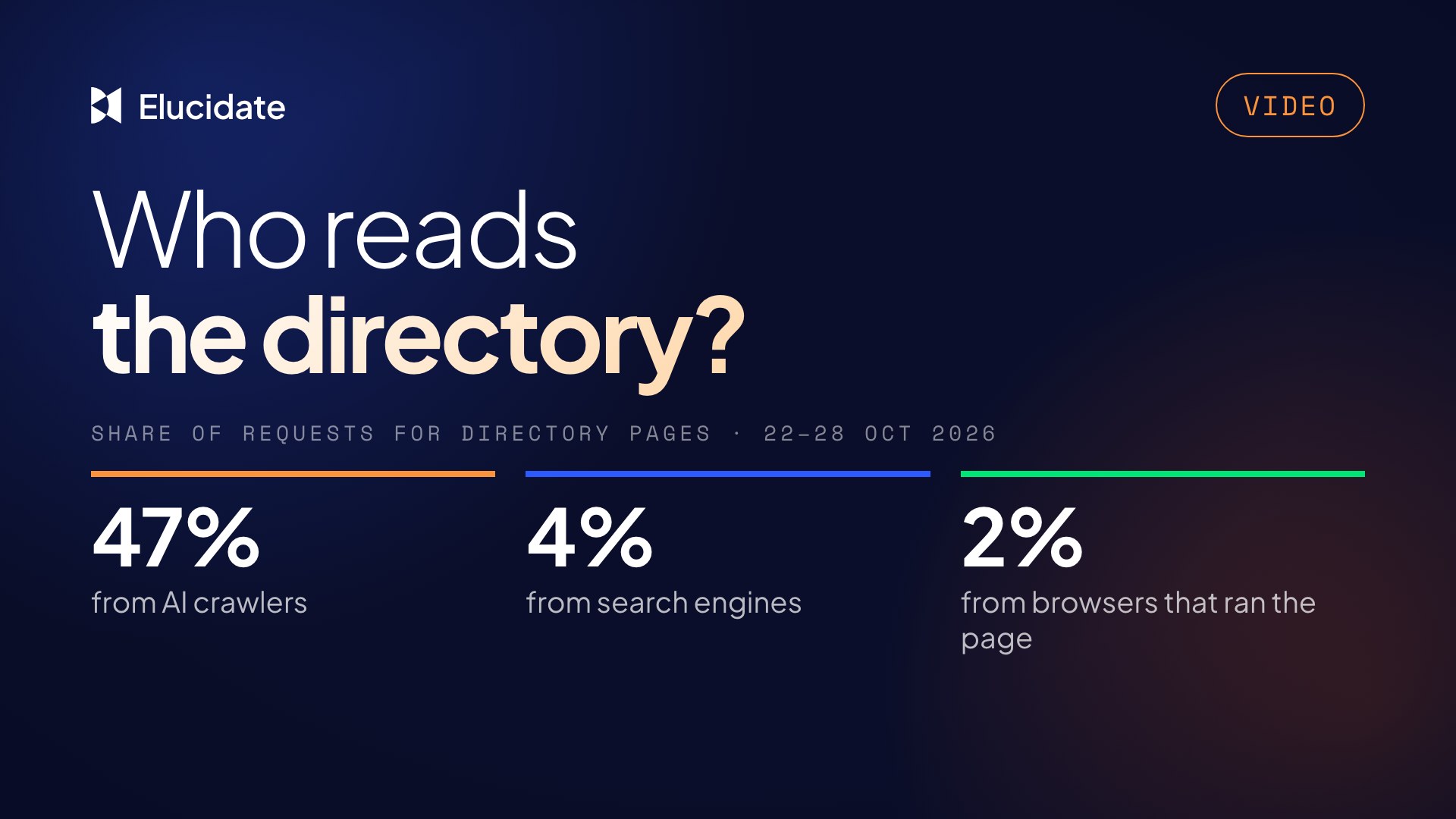
An agent could read our directory pages directly; every page also exists as Markdown for that reason. The MCP server adds what an agent needs to work reliably: named tools with defined inputs, structured answers alongside the text, and the page address to cite with each one. It is read-only, needs no sign-in and serves the same public data as the pages.
The data tools—licences, sanctions, ownership and people—answer only through the server. They have no public URL of their own and sit behind its rate limits, 120 requests a minute per address. Open data and responsible access are not in conflict; they need a front door.
Where Elucidate can help
Any client that supports remote MCP servers can connect to the directory: the address, the tools and the limits are on our page for agents. The directory itself stays free.
Identification is where due diligence starts. For banks and payment firms that need to go further, the Elucidate FinCrime Index (EFI) is an independent score of the financial crime risk of banks and payment firms—comparable to a credit risk rating, applied to financial crime.
An agent is only as good as what it can cite. We would rather it cited the register than guessed.