Introduction
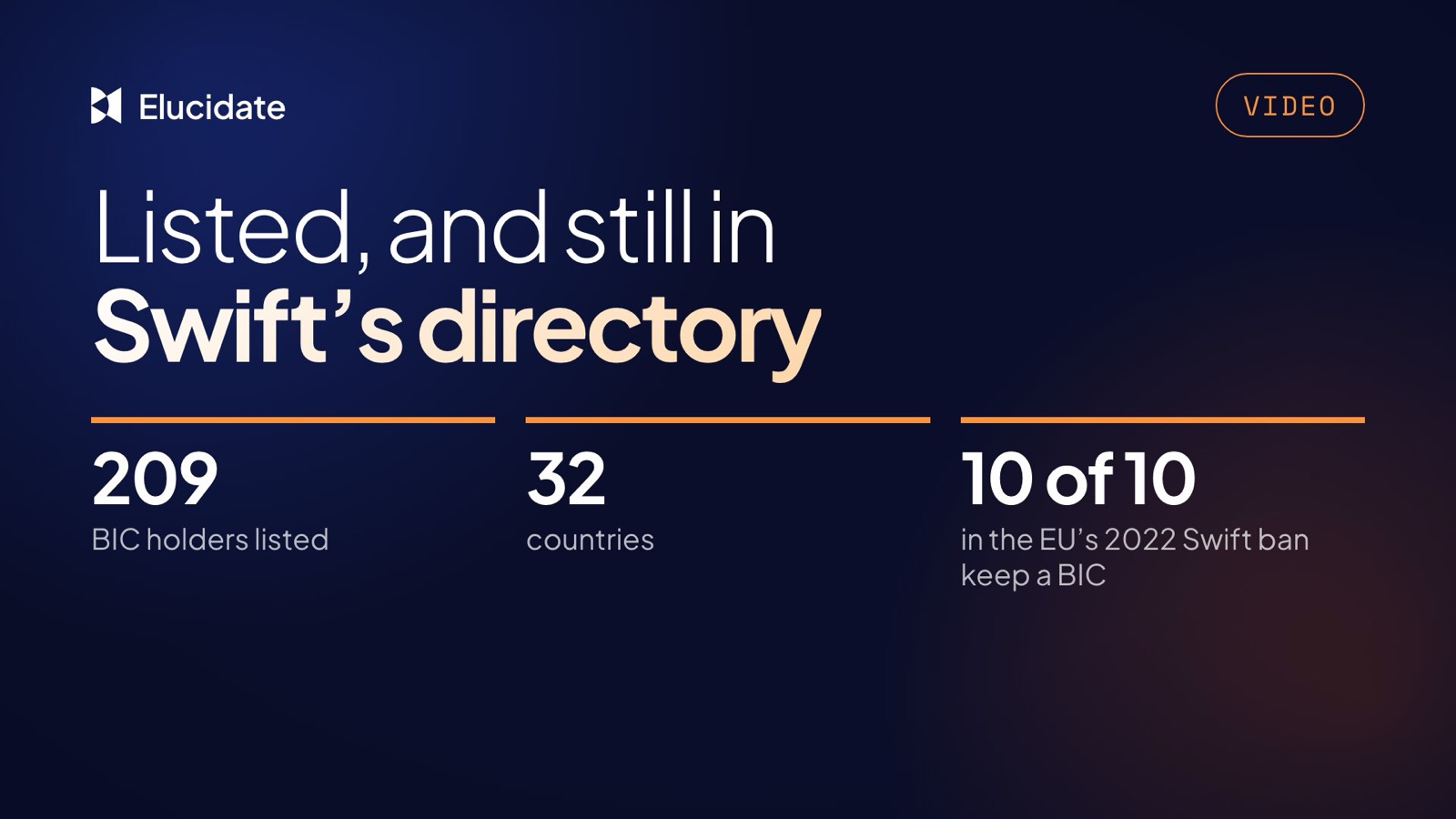
In March 2022 the EU required Swift to stop providing its messaging services to seven Russian banks and, a week later, three Belarusian ones. The decision was reported as a disconnection, and in law it was one. What it did not do was take those banks out of Swift’s directory. Each of the ten still holds a BIC there today.
That matters to anyone who screens counterparties by BIC. A code in the directory is easy to read as a sign that an institution is live on the network—and, by extension, that it is business as usual. We wanted to see how many institutions with a BIC are on a sanctions list, and what the directory can and cannot tell you about them. The video shows what we found.
209 institutions in 32 countries
Of the 36,546 institutions that held a BIC in Swift’s directory as at 24 October 2026, 209 were cited by a listing on the OFAC lists published on 21 October 2026 or the EU consolidated list generated on 23 October 2026. We match a listing to an institution on its BIC and on the LEI mapped to it, so an institution without a BIC is not in the count.
All 209 are on an OFAC list: 204 on the Specially Designated Nationals (SDN) list and five on other OFAC lists. Seventy-five are also on the EU’s list; none is on the EU’s alone. They are in 32 countries, led by Russia (125), Iran (17), North Korea (10), Belarus (6) and the United Kingdom (6); the other 45 are spread across 27 countries.
By the year of their earliest OFAC or EU designation, the listings arrive in waves: 14 in 2014 and 14 in 2015, 37 in 2018—11 of them Iranian—then 17 in 2022, 30 in 2023 and 61 in 2024. In each of 2022, 2023 and 2024, Russian institutions were the large majority: 14, 28 and 59 respectively.
A BIC is not a connection
Here is where the directory is easy to misread. The eighth character of a BIC records how the code is registered: “1” for a passive BIC, used for identification and reached through a correspondent; “2” for reverse billing; anything else for a connected address. Our guide to reading a BIC explains the code in full. Of the 209 listed institutions, 132 hold a BIC coded as connected, 14 reverse billing and 63 passive.
The code does not say whether Swift carries an institution’s messages today. Regulation (EU) 2022/345 prohibited the provision of specialised financial messaging services to seven named Russian banks from 12 March 2022; Regulation (EU) 2022/398 did the same for three Belarusian banks from 20 March 2022; and Article 23(4) of Regulation (EU) No 267/2012 applies the same prohibition to the Iranian entities listed in its annexes. All ten banks named in the two March 2022 regulations still hold a BIC in the directory. Nine of the ten are coded as connected.
The code stays. The service, by law, does not.
So a BIC coded as connected is not evidence that an institution can send or receive Swift messages. And a BIC in the directory is not evidence that an institution can be dealt with freely—only that its code is registered.
Screening is each institution’s job
None of this replaces screening. Screen the counterparty’s BIC, the LEI behind it and its name against the official lists, as published, at the time you deal. Our counts have limits worth stating: an institution appears only if it holds a BIC; matches rely on the BIC and the LEI mapped to it, not on names; and the lists change between editions, while our figures are as at the dates above.
A directory can show where to look. It is not a sanctions screen, and ours does not claim to be one.
Where Elucidate can help
Every institution with a BIC that an OFAC or EU listing cites is on our sanctions page, with the programmes and the date first listed, and each institution’s page in the directory shows the listings that cite it. The directory stays free.
A listing is a yes-or-no fact. Financial crime risk is not. For banks and payment firms that need an independent view of their counterparties, the Elucidate FinCrime Index (EFI) scores the financial crime risk of banks and payment firms—comparable to a credit risk rating, applied to financial crime—with sanctions as one of its nine risk themes.
Listed and connected are two different facts. Read them separately.