Introduction
Regulators publish a great deal. Payment institutions, e-money issuers, money service businesses and crypto-asset service providers all appear on public registers, free to download. Open, however, is not the same as usable. Each register has its own format, its own vocabulary and its own idea of what a row is—and none of them was designed to be read next to the others.
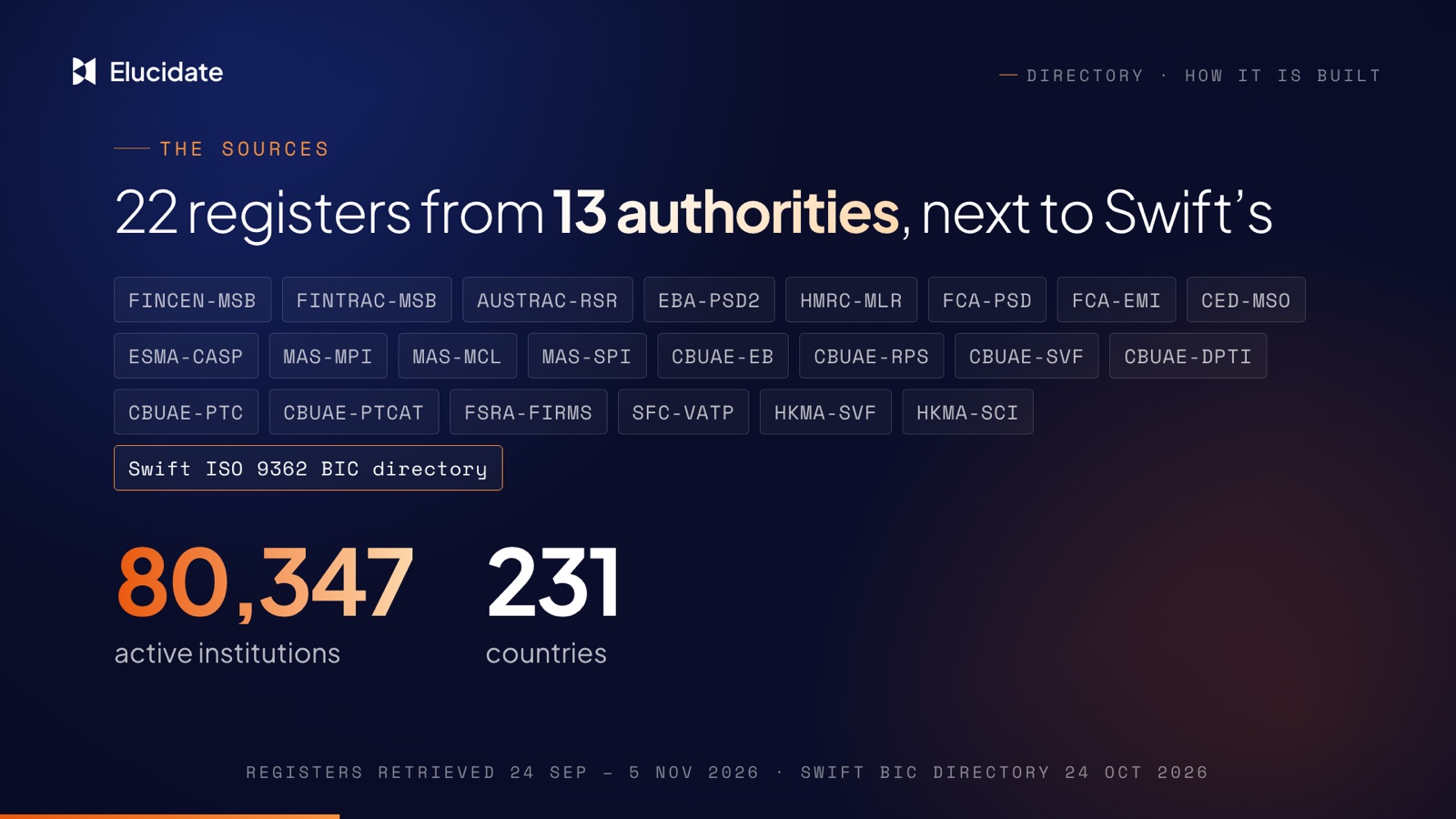
The Elucidate Bank & Firm Directory reads 22 of these registers, from 13 authorities covering 37 countries, alongside Swift’s BIC directory. The result is one dataset of 80,347 active institutions in 231 countries (registers retrieved between 24 September and 5 November 2026; BIC data as at 24 October 2026). The video shows four of the steps in between.
One activity, many words
Registers describe the same activity in different words. A firm that sends money for its customers is an “authorised payment institution” in London, a “major payment institution” in Singapore and a “money transmitter” on FinCEN’s list in the United States. The words are not interchangeable: the first two are prudential licences, with capital and safeguarding requirements; the third is a registration with an anti-money laundering supervisor.
So every firm in the directory gets one of three levels—prudential licence, small-firm registration or AML registration only—and the level is set firm by firm, not register by register. One register can hold several levels: on the FCA’s payment services register, 430 active firms hold a prudential licence and 509 a small-firm registration (register as retrieved on 25 September 2026). Read from the register’s name alone, one group or the other would be wrong.
One row per premises
HMRC’s register of supervised businesses lists every premises separately. Post Office Limited alone has 6,693 rows, all under one registration number (HMRC’s register as retrieved on 24 September 2026). Counted naively, that is 6,693 institutions. In the directory, it is one: rows are collapsed to one entry per registration, with the trading premises behind it.
The same discipline applies elsewhere. The European Banking Authority records a firm’s history as a sequence of authorisations and withdrawals, so current status is read from the whole sequence, not from the latest field.
Identifiers before names
Names are where datasets go wrong. As our post on “Which Citibank?” showed, 3,993 names in the directory are each carried by more than one entry (as at 6 November 2026). So records are joined on identifiers: a register firm and a BIC holder become one institution only when they share a Legal Entity Identifier (LEI). Of the 36,546 institutions that hold a BIC and the 44,705 entries on registers, 904 are joined this way—shown once, with both records.
Nothing deleted, every value dated
Registers forget. A cancelled licence disappears from the next download; a BIC that Swift stops listing is simply absent from the next edition. The directory keeps them: 8,746 inactive institutions remain, marked inactive, with their dates. When a register changes a value, the old one stays in the record’s history. And every value names its source and the date it was retrieved.
This matters more, not less, when the reader is a machine. An AI agent that cannot tell a current licence from one withdrawn last year—or cannot say where a fact came from—will produce a confident answer that no compliance file can accept. Clean data, for an agent, means three things: one vocabulary, one entity per real-world institution, and a source and date on every fact.
Where Elucidate can help
The directory is free to search, and every step above is documented in its methodology: each register, its publisher, what we take from it and how it is matched. Agents can query the same data through our MCP server, with the source and date attached to each answer. Elucidate is certified to ISO/IEC 42001, the standard for AI management systems, and ISO/IEC 27001.
Clean identification is where due diligence starts, not where it ends. For banks and payment firms that need to assess risk, the Elucidate FinCrime Index (EFI) is an independent score of the financial crime risk of banks and payment firms—comparable to a credit risk rating, applied to financial crime.
Public data is a public good only when it can be used. Making it usable is the work.